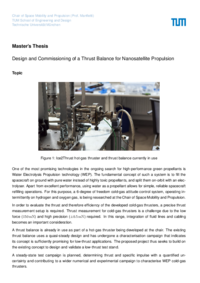
Design and Commissioning of a Thrust Balance for Nanosatellite Propulsion
- Institute
- Lehrstuhl für Raumfahrtantriebe (TUM-ED)
- Type
- Master's Thesis
- Content
- experimental
- Description
One of the most promising technologies in the ongoing search for high-performance green propellants is Water Electrolysis Propulsion technology (WEP). The fundamental concept of such a system is to fill the spacecraft on ground with pure water instead of highly toxic propellants, and split them on-orbit with an electrolyser. Apart from excellent performance, using water as a propellant allows for simple, reliable spacecraft refilling operations. For this purpose, a 6-degree of freedom cold-gas attitude control system, operating intermittently on hydrogen and oxygen gas, is being researched at the Chair of Space Mobility and Propulsion.
In order to evaluate the thrust and therefore efficiency of the developed cold-gas thrusters, a precise thrust measurement setup is required. Thrust measurement for cold-gas thrusters is a challenge due to the low force (150 mN) and high precision (+/- 0.5 mN) required. In this range, integration of fluid lines and cabling becomes an important consideration.
A thrust balance is already in use as part of a hot-gas thruster being developed at the chair. The existing thrust balance uses a quasi-steady design and has undergone a characterisation campaign that indicates its concept is sufficiently promising for low-thrust applications. The proposed project thus seeks to build on the existing concept to design and validate a low-thrust test stand.
A steady-state test campaign is planned, determining thrust and specific impulse with a quantified uncertainty and contributing to a wider numerical and experimental campaign to characterise WEP cold-gas thrusters.
Tasks
- Familiarisation with current thrust balance design and literature review of low thurst balance state of the art.
- Feasibility analysis of an improved quasi-steady concept with respect to the laid out requirements.
- Conceptual design iteration and component selection
- Implementation and testing of the proposed design
- Steady-state testing, error analysis, and analysis of the system dynamics of the test stand
- Documentation and review of requirements satisfaction
- Requirements
Student in Aerospace or Mechanical Engineering.
Experience with and demonstrated interest in hardware assembly is a plus.
Experience with electrical or data acquisition hardware and software is a plus.- Possible start
- sofort
- Contact
-
Tomas Mrazek, M.Eng.
Phone: +33695349960
tomas.mrazektum.de - Announcement
-