Optimization of a Cohesive Zone Model to Predict Needle Insertion Forces in Carbon-Fiber Preforms for Advanced Space Manufacturing
- Institute
- Lehrstuhl für Carbon Composites (TUM-ED)
- Type
- Bachelor's Thesis Semester Thesis Master's Thesis
- Content
- theoretical
- Description
The performance of cryogenic liquid rocket engines can be significantly improved through the use of nozzle
extensions that increase exhaust gas velocity and overall propulsion efficiency. Among the most promising advancements
in this field are composite nozzle extensions (CNE) that offer a drastic reduction in engine mass,
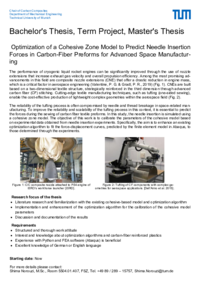
which is a critical factor in aerospace engineering (Valentine, P. G. & Gradl, P. R., 2019) (Fig. 1). CNEs are built
based on a two-dimensional textile structure, strategically reinforced in the third dimension through advanced
carbon fiber (CF) stitching. Cutting-edge textile manufacturing techniques, such as tufting (one-sided sewing),
enable the cost-effective production of lightweight complex geometries within the aerospace field (Fig. 2).
The reliability of the tufting process is often compromised by needle and thread breakage in space-related manufacturing.
To improve the reliability and scalability of the tufting process in this context, it is essential to predict
the forces during the sewing of carbon fiber textile preforms. In this study, the needle insertion is simulated using
a cohesive zone model. The objective of this work is to calibrate the parameters of the cohesive model based
on experimental data obtained from needle insertion experiments. Specifically, the aim is to enhance an existing
optimization algorithm to fit the force-displacement curves, predicted by the finite element model in Abaqus, to
those determined through the experiments.Research focus of the thesis:
- Literature research and familiarization with the existing cohesive-based model and optimization algorithm
- Implementation and enhancement of the optimization algorithm for the calibration of the cohesive model
parameters - Discussion and documentation of the results
- Requirements
Requirements:
- Structured and thorough work attitude
- Interest and knowledge about optimization algorithms and carbon-fiber reinforced plastics
- Experience with Python and FEA software (Abaqus) is beneficial
- Excellent knowledge of German or English language
- Possible start
- sofort
- Contact
-
Shima Norouzi, M.Sc.
Room: 5504.01.407
Phone: +49 89 289 15757
shima.norouzitum.de - Announcement
-