Group Thesis: Engineering of Laboratory Setup for a Capillary Fed Water Electrolyser for Space Applications
- Institute
- Lehrstuhl für Raumfahrtantriebe (TUM-ED)
- Type
- Bachelor's Thesis Semester Thesis Master's Thesis
- Content
- experimental theoretical constructive
- Description
Topic: Water Electrolysis Propulsion for Space Applications
Water Electrolysis Propulsion (WEP) is a promising technology for high-performance, green propulsion systems for space applications. By using water as a propellant, spacecraft can avoid toxic and hazardous chemicals while potentially extending mission lifetimes through in-situ resource utilization (ISRU).
However, conventional water electrolysis systems face a major challenge in space: the separation of gases and liquids under microgravity or zero-gravity conditions. On Earth, buoyancy can be used to separate the generated hydrogen and oxygen from the liquid phase. In space, this mechanism is no longer available.
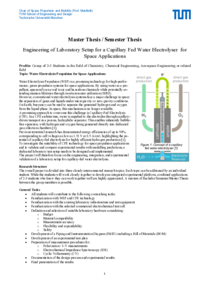
A promising approach to overcome this challenge is Capillary-Fed Electrolysis (CFE). In a CFE architecture, water is supplied to the electrodes through capillary-driven transport in a porous, hydrophilic separator. This enables inherently bubble-free operation, with hydrogen and oxygen being generated directly into dedicated gas collection chambers [1].
Previous terrestrial research has demonstrated energy efficiencies of up to 98%, corresponding to cell voltages as low as 1.51 V at 0.5 A/cm², highlighting the potential of capillary-fed electrolysis for highly efficient hydrogen production [1].
To investigate the suitability of CFE technology for space propulsion applications and to validate and compare experimental results with modelling predictions, a dedicated laboratory test setup needs to be designed and implemented.
The project will therefore focus on the engineering, integration, and experimental validation of a laboratory setup for capillary-fed water electrolysis.
Research Structure
The overall project is divided into three closely interconnected research topics. Each topic can be addressed by an individual student. While the students will work closely together to develop an integrated experimental platform, combined applications of 2-3 students who know they can work together well are highly appreciated. A mixture of Bachelor/Semester/Master Thesis between the group members is possible.
General Tasks
- All students will contribute to the following overarching tasks:
- Familiarization with WEP and CFE technology
- Familiarization with the existing laboratory infrastructure and test equipment
- Familiarization with the selected commercial electrochemical test cell
- Definition and selection of suitable laboratory hardware considering:
- Budget
- Material compatibility
- Measurement accuracy
- Flexibility and expandability
- Safety
- Development of a Piping and Instrumentation Diagram (P&ID) including a Bill of Materials (BOM)
- Development of an experimental test plan
- Preparation of measurement procedures for:
- Polarization / I–V measurements
- Electrochemical Impedance Spectroscopy (EIS)
- Cyclic Voltammetry (CV)
- Documentation of the design process and experimental results
- Final presentation of the results
Expected Overall Outcome
The overall objective of the project is to establish the engineering basis for a flexible laboratory platform for the experimental investigation of capillary-fed water electrolysis under conditions relevant to future space propulsion applications.
The work will combine:
Electrochemistry, Fluid Management, Mechanical Design, Instrumentation, Safety, Experimental Validation, Aerospace Engineering
The project therefore offers the opportunity to work at the interface of electrochemical engineering, laboratory-scale system engineering, and space propulsion technology.
Research Topic 1
Integration of the Test Setup into the Existing Laboratory
The current test stand was originally designed for PEM cathode-vapor-fed electrolysis. Its suitability for capillary-fed electrolysis using alkaline electrolytes therefore needs to be assessed. PEM tests are also still performed in the future; the target is a flexible setup that integrates smoothly into the existing platform.
Main tasks
Analysis of the existing laboratory test stand and identification of required modifications
- Assessment of the compatibility of existing components with alkaline electrolytes
- Evaluation of material compatibility, including:
- Tubing and fittings
- Seals and gaskets
- Valves
- Sensors
- Pumps and other fluid-handling components
- Assessment of the existing measurement and control systems
- Investigation of the effects of alkaline solution (CFE) vs. deionized Water (PEM)
- Investigation of the effects of elevated operating pressures
- Evaluation and design of the required thermal management
- Identification of additional sensors and instrumentation required for CFE operation
- Integration of the test cell into the existing laboratory infrastructure
- Development of experiments to verify critical assumptions and design decisions
- Development of a safety concept for the modified test setup
Expected outcome
A validated concept for the integration of a capillary-fed electrolysis test cell into the existing laboratory infrastructure, including the required hardware modifications, instrumentation, safety measures, and experimental verification strategy.
Research Topic 2
Modification of the Redox-Flow M-Cell for Capillary-Fed Electrolysis
The Redox-Flow® M-Cell provides a compact platform for electrochemical testing and will be evaluated and modified to enable CFE operation.
Main tasks
- Analysis of the M-Cell design and its suitability for CFE experiments
- Development of a concept for integrating a water/electrolyte reservoir
- Development of a concept for water/electrolyte separation
- Selection and integration of a suitable porous hydrophilic separator
- Modification of the flow field
- Evaluation and modification of the gas diffusion electrode, including development of a concept for future integration of an ePTFE layer
- Investigation of suitable sealing and compression concepts
- Development of a high-pressure-compatible cell concept
- Evaluation of pressure containment and material compatibility
- Development of a concept for space-representative testing conditions
- Experimental characterization of the modified cell
Expected outcome
A modified M-Cell concept suitable for laboratory investigation of capillary-fed water electrolysis, including a defined architecture for water supply, gas collection, pressure operation, and electrochemical characterization.
Research Topic 3
Modification of the Redox-Flow X-Cell for Capillary-Fed Electrolysis
The objective is to assess whether a larger or differently configured test cell can provide additional experimental capabilities compared with the Redox-Flow® M-Cell. This could be Redox-Flow® X-Cell or another commercial off-the-shelf cell.
Main tasks
- Market analysis on suitable commercial test cells
- Development of a concept for integrating a water/electrolyte reservoir
- Development of a concept for water/electrolyte separation
- Selection and integration of a suitable porous hydrophilic separator
- Modification of the flow field
- Evaluation and modification of the gas diffusion electrode, including development of a concept for future integration of an ePTFE layer
- Investigation of suitable sealing and compression concepts
- Development of a high-pressure-compatible cell concept
- Evaluation of pressure containment and material compatibility
- Development of a concept for space-representative testing conditions
- Experimental characterization of the modified cell
Expected outcome
A modified X-Cell or similar concept suitable for laboratory investigation of capillary-fed water electrolysis, including a defined architecture for water supply, gas collection, pressure operation, and electrochemical characterization.
- Requirements
Profile: Group of 2-3 Students in the field of Chemistry, Chemical Engineering, Aerospace Engineering or related field
Application
Individual applications are accepted, applications as a group of 2–3 students are strongly encouraged.
For group applications, we prefer one joint motivation letter describing the shared motivation for the project as well as the individual interests of each team member. Please indicate which of the three research topics each student would be most interested in and how you would envision dividing the work within the group.Please also address the following points:
- What specifically interests you about capillary-fed electrolysis and its application to space propulsion?
- Which research topic would you be most interested in, and why?
- Identify one technical challenge that you consider particularly interesting or critical for the successful implementation of the experiment. Briefly explain your reasoning.
- Formulate one technical question that you would like to ask us about the project.
Please write the motivation in your own words. During the interview, we will discuss the motivation and technical considerations described in the application.
Please submit the following documents by e-mail:
- Joint motivation letter for group applications, including the individual interests of all applicants
- CV of each applicant
- Bachelor's diploma/certificate, if available
- Current grade report / transcript of records for each applicant
Application deadline: Please submit your application by October 15th.The thesis can start from October 15th, with the exact starting date to be agreed upon individually.
Contact
Fabian Riegelsberger, M.Sc.
Technical University of Munich (TUM)Phone: +49 89 289 16170
<noscript>(at)</noscript>tum.de
E-Mail: fabian.riegelsberger<script>document.write('@');</script>- Possible start
- sofort
- Contact
-
Fabian Riegelsberger, M.Sc.
Room: Ottobrunn, Carolin-Herschelstr. 100 3.OG
fabian.riegelsbergertum.de - Announcement
-