Experimental Investigation of the Flow Behaviour of a Capillary Fed Water Electrolyser Separator for Space Applications
- Institute
- Lehrstuhl für Raumfahrtantriebe (TUM-ED)
- Type
- Bachelor's Thesis Semester Thesis Master's Thesis
- Content
- experimental
- Description
Topic
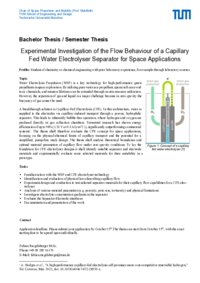
Water Electrolysis Propulsion (WEP) is a key technology for high-performance green propellants in space exploration. By utilizing pure water as a propellant, spacecraft can avoid toxic chemicals, and mission lifetimes can be extended through in-situ resource utilization. However, the separation of gas and liquid is a major challenge because in zero-gravity the buoyancy of gas cannot be used.A breakthrough solution is Capillary-Fed Electrolysis (CFE). In this architecture, water is supplied to the electrodes via capillary-induced transport through a porous, hydrophilic separator. This leads to inherently bubble-free operation, where hydrogen and oxygen are produced directly in gas collection chambers. Terrestrial research has shown energy efficiencies of up to 98% (1.51 V at 0.5 A/(cm^2 )), significantly outperforming commercial systems. The thesis shall therefore evaluate the CFE concept for space applications, focusing on the physical-chemical limits of capillary transport and the potential for a simplified, pump-free stack design. The thesis shall analyse theoretical boundaries and optimal material parameters of capillary flow under zero-gravity conditions. To lay the foundation for CFE electrolyser designs it shall identify suitable separator and electrode materials and experimentally evaluate some selected materials for their suitability in a prototype.
Tasks
- Familiarization with the WEP and CFE electrolyser technology
- Identification and evaluation of physical laws describing capillary flow
- Experiment design and conduction to test selected separator materials for their capillary flow capabilities for a CFE electrolyser
- Analysis of various material parameters (e.g. porosity, pore size, tortuosity) and physical limitations
- Investigate electrolyte concentration gradients in the separator
- Evaluate the Separator-Electrode interfaces
- Documentation and presentation of the work
A. Hodges et al., “A high-performance capillary-fed electrolysis cell promises more cost-competitive renewable hydrogen,” Nat Commun, Mar. 2022, doi: 10.1038/s41467-022-28953-x.
- Requirements
Profile: Student of chemistry or chemical engineering with prior laboratory experience, for example through laboratory courses.
- Possible start
- 15.10.2026
- Contact
-
Fabian Riegelsberger, M.Sc.
Room: Ottobrunn, Carolin-Herschelstr. 100 3.OG
fabian.riegelsbergertum.de - Announcement
-