Investigation of interface behavior and joining strategies in multi material fused filament fabrication
- Institute
- Lehrstuhl für Carbon Composites (TUM-ED)
- Type
- Bachelor's Thesis Semester Thesis
- Content
- experimental theoretical
- Description
A project is currently being developed at the Chair of Carbon Composites to exploit the flexibility of additive manufacturing to print sustainable synchronous reluctance motors (SynRMs). In SynRMs, the specially designed anisotropic rotors tend to align their axis of minimum magnetic resistance (reluctance) with the rotating magnetic field. This generates torque, causing the rotor to rotate at the same speed as the magnetic field. Compared with other synchronous motor types, SynRMs offer several advantages: their rotors require neither permanent excitation, copper windings, nor permanent magnets. Moreover, unlike induction motors, their operation does not rely on rotor-induced currents, thereby reducing rotor losses and heating. Consequently, SynRMs can achieve higher efficiencies than comparable induction motors.
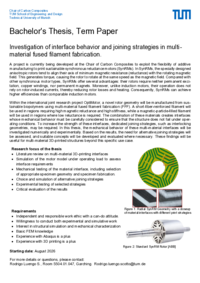
Within the international joint research project OptiMotor, a novel rotor geometry will be manufactured from sustainable biopolymers using multi-material fused filament fabrication (FFF). A short-fiber-reinforced filament will be used in regions requiring high magnetic reluctance and high stiffness, while a magnetic-particle-filled filament will be used in regions where low reluctance is required. The combination of these materials creates interfaces whose mechanical behavior must be carefully considered to ensure that the structure does not fail under operating conditions. To increase the strength of these interfaces, dedicated joining strategies, such as interlocking geometries, may be required. In this thesis, the mechanical behavior of these multi-material interfaces will be investigated numerically and experimentally. Based on the results, the need for alternative joining strategies will be assessed, and suitable concepts will be developed and evaluated where necessary. These findings will be useful for multi-material 3D-printed structures beyond this specific use case.
Research focus of the thesis
• Literature review on multi-material 3D-printing interfaces
• Simulation of the motor model under operating load to assess interface requirements
• Mechanical testing of the material interface, including selection of appropriate specimen geometry and specimen fabrication.
• Choice and simulation of alternative joining strategies
• Experimental testing of selected strategies
• Critical evaluation of the results
- Requirements
• Independent and responsible work ethic with a can-do attitude.
• Willingness to conduct both experimental and simulative work
• Interest in structural simulation and mechanical characterization
• Basic FEM knowledge
• Experience with Abaqus is a plus
• Experience with 3D printing is a plus
- Possible start
- sofort
- Contact
-
Rodrigo Luengo Scotto, M.Sc.
Room: 5504.01.407
Phone: 089 289 15786
rodrigo.luengo.scottotum.de - Announcement
-