Motion Prediction with SD Maps for Generalizable Autonomous Driving
- Institute
- Lehrstuhl für Fahrzeugtechnik (TUM-ED)
- Type
- Semester Thesis Master's Thesis
- Content
- experimental theoretical
- Description
Learned motion prediction for autonomous driving is typically conditioned on HD or lanelet maps. These maps provide precise lane-level geometry, but they are expensive to create, to maintain and to keep up to date. In practice, automated driving is therefore restricted to the few areas that have been mapped, and map generation – not the prediction model – becomes the bottleneck for deployment.
SD maps such as OpenStreetMap are available almost everywhere and already carry much of the context a prediction model needs: road topology and connectivity, intersections, road classes and speed limits, traffic light and stop positions, and parking areas. What they do not provide is lane-level geometry – which raises the question of how much of the achievable prediction performance actually depends on it.
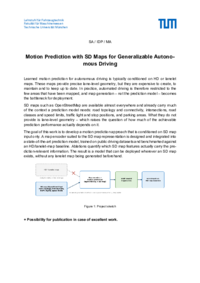
The goal of this work is to develop a motion prediction approach that is conditioned on SD map input only. A map encoder suited to the SD map representation is designed and integrated into a state-of-the-art prediction model, trained on public driving datasets and benchmarked against an HD/lanelet-map baseline. Ablations quantify which SD map features actually carry the pre diction-relevant information. The result is a model that can be deployed wherever an SD map exists, without any lanelet map being generated beforehand.
+ Possibility for publication in case of excellent work.
Work packages:
- Literature review: map representations for motion prediction.
- SD map data pipeline: feature extraction and alignment with the datasets.
- SD map encoder integrated into a state-of-the-art prediction model.
- Training and ablation of the SD map feature set.
- Benchmark against an HD/lanelet-map baseline.
- Requirements
Requirements:
- Very good programming skills in Python.
- High personal motivation and independent working style.
- Very good language proficiency in German, English or French.
- Software
- Python, C++, ROS2
- Tags
- FTM AV, FTM AV Perception, FTM Stratil, FTM Informatik
- Possible start
- sofort
- Contact
-
Loïc Stratil, M.Sc.
Room: MW 3508
Phone: +49.89.289.15898
loic.stratiltum.de - Announcement
-