High-Fidelity Traffic Light Detection Dataset for Autonomous Buses in Munich – Dataset Generation and Publication
- Institute
- Lehrstuhl für Fahrzeugtechnik (TUM-ED)
- Type
- Bachelor's Thesis Semester Thesis
- Content
- experimental theoretical
- Description
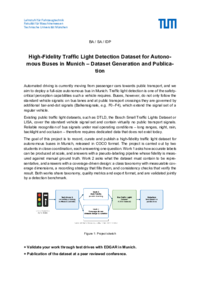
Automated driving is currently moving from passenger cars towards public transport, and we aim to deploy a full-size autonomous bus in Munich. Traffic light detection is one of the safety critical perception capabilities such a vehicle requires. Buses, however, do not only follow the standard vehicle signals: on bus lanes and at public transport crossings they are governed by additional bar-and-dot signals (Balkensignale, e.g. F0–F4), which extend the signal set of a regular vehicle. Existing public traffic light datasets, such as DTLD, the Bosch Small Traffic Lights Dataset or LISA, cover the standard vehicle signal set and contain virtually no public transport signals. Reliable recognition of bus signals under real operating conditions – long ranges, night, rain, backlight and occlusion – therefore requires dedicated data that does not exist today.
The goal of this project is to record, curate and publish a high-fidelity traffic light dataset for autonomous buses in Munich, released in COCO format. The project is carried out by two students in close coordination, each answering one question. Work 1 asks how accurate labels can be produced at scale, and answers with a pseudo-labeling pipeline whose fidelity is meas ured against manual ground truth. Work 2 asks what the dataset must contain to be repre sentative, and answers with a coverage-driven design: a class taxonomy with measurable cov erage dimensions, a recording strategy that fills them, and consistency checks that verify the result. Both works share taxonomy, quality metrics and export format, and are validated jointly by a detection benchmark.
Work 1 – High-fidelity pseudo-labeling pipeline:
- Literature review: traffic light detection, auto- and pseudo-labeling, label quality assurance.
- Design and implementation of a pseudo-labeling pipeline: label proposals, temporal association, class and state assignment.
- Uncertainty estimation and flagging of ambiguous samples for human-in-the loop refinement.
- Validation against a manually labeled ground truth subset and iterative improvement of label fidelity.
- COCO-compliant label export and integration with the annotation tooling.
Work 2 – Coverage-driven dataset design and curation:
- Review of existing traffic light datasets: class taxonomies, coverage and evaluation protocols.
- Dataset specification: class taxonomy and measurable coverage dimensions (distance, illumination, weather, occlusion, signal state).
- Recording strategy and test drives with EDGAR that systematically fill the specified coverage.
- Curation pipeline: frame selection, consistency checks, anonymization and dataset splits.
- Benchmark: quantify coverage and class balance, and validate the dataset with a detection baseline.
Joint work packages:
- Alignment of class taxonomy, label quality metrics and COCO interface between both works.
- Release of the dataset and contribution to the accompanying scientific publication.
- Requirements
Requirements:
- Very good programming skills in Python; experience with deep learning (PyTorch) and computer vision is an advantage.
- Familiarity with ROS2 and rosbag data handling is beneficial.
- High personal motivation, independent working style and close coordination with a fellow student.
- Very good language proficiency in German, English or French.
- Software
- Python, C++, ROS2
- Tags
- FTM AV, FTM AV Perception, FTM Stratil, FTM Informatik
- Possible start
- sofort
- Contact
-
Loïc Stratil, M.Sc.
Room: MW 3508
Phone: +49.89.289.15898
loic.stratiltum.de - Announcement
-