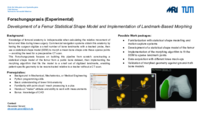
Development of a Femur Statistical Shape Model and Implementation of Landmark-Based Morphing
- Institute
- TUM Munich Institute of Robotics and Machine Intelligence (Institut)
- Type
- Semester Thesis Master's Thesis
- Content
- Description
Knowledge of femoral anatomy is indispensable when calculating the relative movement of femur and tibia during knee surgery. Commercial navigation systems obtain this anatomy by having the surgeon digitize a small number of bone landmarks with a tracked probe, then use a statistical shape model (SSM) to morph a mean bone shape onto these sparse points — avoiding the need for a preoperative CT scan.
This Forschungspraxis focuses on building this pipeline from scratch: constructing a statistical shape model of the femur from a public bone dataset, then implementing the morphing algorithm that fits the model to a small set of digitized landmarks, enabling patient-specific geometry to be reconstructed relative to a tracker without a CT scan.
Possible Work packages:
- Familiarization with statistical shape modelling and motion capture systems
- Development of a statistical shape model of the femur
- Implementation of the morphing algorithm to fit the SSM to sparse landmark points
- Data acquisition with different knee mock-ups
- Validation of morphed geometry against ground-truth bone models
- Requirements
- Background in Mechanical, Mechatronics, or Medical Engineering
- Python programming skills
- Basic understanding of lower limb anatomy
- Familiarity with point cloud / mesh processing is a plus
- Hands-on "maker" attitude and ability to work with measurements
- Bonus: knowledge of CAD
- Possible start
- sofort
- Contact
-
Alexander Gérard
alexander.gerardtum.de - Announcement
-