Design and Testing of a Near-Field Sensing Array for Satellite Docking Applications
- Institute
- Lehrstuhl für Raumfahrtantriebe (TUM-ED)
- Type
- Semester Thesis Master's Thesis
- Content
- Description
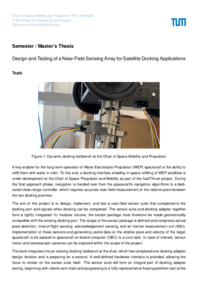
A key enabler for the long-term operation of Water Electrolysis Propulsion (WEP) spacecraft is the ability to refill them with water in orbit. To this end, a docking interface enabling in-space refilling of WEP satellites is under development at the Chair of Space Propulsion and Mobility as part of the Ice2Thrust project. During the final approach phase, navigation is handed over from the spacecraft's navigation algorithms to a dedicated close-range controller, which requires accurate near-field measurement of the relative pose between the two docking partners.
The aim of this project is to design, implement, and test a near-field sensor suite that complements the docking port and signals when docking can be completed. The sensor suite and docking adapter together form a tightly integrated 1U modular volume; the sensor package must therefore be made geometrically compatible with the existing docking port. The scope of the sensor package is defined and comprises optical pose detection, time-of-flight sensing, acknowledgement sensing, and an inertial measurement unit (IMU). Implementation of these sensors and generating useful data on the relative pose and velocity of the target spacecraft to be passed to spacecraft on-board computer (OBC) is a core task. In case of interest, sensor fusion and stereoscopic cameras can be explored within the scope of the project.
The work integrates into an existing docking testbench at the chair, which has completed one docking adapter design iteration and is preparing for a second. A well-defined hardware interface is provided, allowing the focus to remain on the sensor suite itself. The sensor suite will form an integral part of docking adapter testing, beginning with robotic-arm trials and progressing to a fully representative floating-platform test at the Zero-G Lab of the University of Luxembourg.
This thesis involves a short design phase followed by an extensively hands-on implementation and testing effort, offering experience with a broad range of hardware. A demonstrated interest in hardware hacking or electronics projects is considered an advantage.
Tasks:
- Familiarisation with docking adapter and testbench
- Sensor layout definition, including consideration of available lines of sight, possible obstructions, and lighting conditions.
- Assembly and testing of sensor hardware
- Definition of OBC communication and programming
- Calibration and evaluation using an optical table
- Integration and testing with dynamic docking testbench
- Requirements
- Student in Informatics, Aerospace or Mechanical Engineering.
- Experience with and demonstrated interest in electronics projects is a plus.
- Basic knowledge of Linux or embedded computing is a plus.
- Possible start
- sofort
- Contact
-
Tomas Mrazek, M.Eng.
Phone: +33695349960
tomas.mrazektum.de - Announcement
-