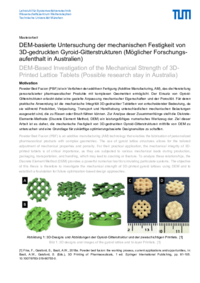
DEM-basierte Untersuchung der mechanischen Festigkeit von 3D-gedruckten Gyroid-Gitterstrukturen (Möglicher Forschungsaufenthalt in Australien)
- Institute
- Lehrstuhl für Fördertechnik Materialfluss Logistik (TUM-ED)
- Type
- Master's Thesis
- Content
- Description
Motivation
Powder Bed Fusion (PBF) ist ein Verfahren der additiven Fertigung (Additive Manufacturing, AM), das die Herstellung personalisierter pharmazeutischer Produkte mit komplexen Geometrien ermöglicht. Der Einsatz von Gyroid Gitterstrukturen erlaubt dabei eine gezielte Anpassung mechanischer Eigenschaften und der Porosität. Für deren praktische Anwendung ist die mechanische Integrität 3D-gedruckter Tabletten von entscheidender Bedeutung, da sie während Produktion, Verpackung, Transport und Handhabung unterschiedlichen mechanischen Belastungen ausgesetzt sind, die zu Rissen oder Bruch führen können. Zur Analyse dieser Zusammenhänge stellt die Diskrete Elemente-Methode (Discrete Element Method, DEM) ein leistungsfähiges numerisches Werkzeug dar. Ziel dieser Arbeit ist es daher, die mechanische Festigkeit von 3D-gedruckten Gyroid-Gitterstrukturen mithilfe von DEM zu untersuchen und eine Grundlage für zukünftige optimierungsbasierte Designansätze zu schaffen.
Powder Bed Fusion (PBF) is an additive manufacturing (AM) technology that enables the fabrication of personalized pharmaceutical products with complex geometries. The use of gyroid lattice structures allows for the tailored adjustment of mechanical properties and porosity. For their practical application, the mechanical integrity of 3D printed tablets is of critical importance, as they are subjected to various mechanical loads during production, packaging, transportation, and handling, which may lead to cracking or fracture. To analyze these relationships, the Discrete Element Method (DEM) provides a powerful numerical tool for simulating particulate systems. The objective of this thesis is therefore to investigate the mechanical strength of 3D-printed gyroid lattices using DEM and to establish a foundation for future optimization-based design approaches.
[1] Fina, F., Gaisford, S., Basit, A.W., 2018a. Powder bed fusion: the working process, current applications and opportunities, in: Basit, A.W., Gaisford, S. (Eds.), 3D Printing of Pharmaceuticals, 1 ed. Springer International Publishing, pp. 81-105. 10.1007/9783-319-90755-0.
Arbeitsziele
Ziel dieser Masterarbeit ist die Entwicklung und Anwendung eines DEM-basierten Simulationsmodells zur Untersuchung der mechanischen Festigkeit von 3D-gedruckten Gyroid-Gitterstrukturen im pharmazeutischen Kontext. Die spezifischen Ziele umfassen:
• Einarbeitung in den Stand der Forschung zu PBF-basierender Tabletten und DEM-Simulationen.
• Aufbau eines DEM-Modells zur Analyse von Gyroid-Gitterstrukturen.
• Untersuchung des Einflusses von Partikelgrößenverteilung und Kontaktmodellen auf die Mechanik.
• Bewertung der strukturellen Stabilität unter verschiedenen mechanischen Belastungen.
• Identifikation kritischer Belastungsszenarien entlang des Lebenszyklus pharmazeutischer Tabletten.
• Analyse relevanter DEM-Eingangs- und Ausgangsparameter.
• Ableitung potenzieller Schnittstellen zu zukünftigen Topologieoptimierungsansätzen.
The objective of this master’s thesis is to develop and apply a DEM-based simulation model to investigate the mechanical strength of 3D-printed gyroid lattice structures in a pharmaceutical context. The specific objectives are as follows:
• To review the state of the art in Powder Bed Fusion (PBF)-based tablet manufacturing and DEM simulations.
• To develop a DEM model for the analysis of gyroid lattice structures.
• To investigate the influence of particle size distribution and contact models on mechanical behavior.
• To evaluate the structural stability under various mechanical loading conditions.
• To identify critical loading scenarios throughout the lifecycle of pharmaceutical tablets.
• To analyze relevant DEM input and output parameters.
• To derive potential interfaces for future topology optimization approaches.
- Requirements
Internationale Forschungsmöglichkeit – DAAD PPP
Diese Masterarbeit ist Teil des DAAD-Programms „Programmes for Project-Related Personal Exchange (PPP)“ und erfolgt in Kooperation zwischen der Technischen Universität München (TUM) und der Swinburne University of Technology in Australien. Die ausgewählte Studentin bzw. der ausgewählte Student erhält die Möglichkeit zu einem 2–3-wöchigen Forschungsaufenthalt an der Swinburne University of Technology.
International research opportunity – DAAD PPP
This master’s thesis is part of the DAAD Programme for Project-Related Personal Exchange (PPP), a collaboration between the Technical University of Munich (TUM) and Swinburne University of Technology, Melbourne, Australia. The selected student will have the opportunity to undertake a 2–3-week research stay at Swinburne University of Technology.
Beginn/Start
Sofort/Immediately
Kontakt/Contact:
Technische Universität München
Lehrstuhl für Systemverfahrenstechnik
Yuan Tan
Gregor-Mendel-Straße 4 (EG02), 85354 Freising
Tel. +49 8161 71-5172
Yuan.tan@tum.de
- Possible start
- sofort
- Contact
-
Minggong Yu, M.Sc.
Room: 5505.01.590D
Phone: 089 / 289 15947
minggong.yutum.de - Announcement
-