Development of a Python-Based Nonplanar Slicer for Continuous Fiber Robotic 3D Printing
- Institute
- Lehrstuhl für Carbon Composites (TUM-ED)
- Type
- Bachelor's Thesis Semester Thesis Master's Thesis
- Content
- Description
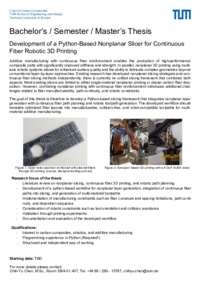
Additive manufacturing with continuous fiber reinforcement enables the production of high-performance composite parts with significantly improved stiffness and strength. In parallel, nonplanar 3D printing using multi-axis robotic systems allows for enhanced surface quality and the ability to fabricate complex geometries beyond conventional layer-by-layer approaches. Existing research has developed nonplanar slicing strategies and continuous fiber slicing methods independently, there is currently no unified slicing framework that combines both aspects. Most existing slicers are limited to either single-material nonplanar printing or planar carbon fiber deposition. However, combining nonplanar printing with continuous fiber reinforcement introduces additional challenges related to fiber manufacturability, path continuity, and robotic constraints.The goal of this thesis is therefore to develop a Python-based slicing framework that integrates nonplanar layer generation with continuous fiber path planning and robotic toolpath generation. The developed workflow should translate optimized fiber layouts into manufacturable, collision-free, and robot-compatible toolpaths for multi-material additive manufacturing.
- Requirements
Research focus of the thesis - Literature review on nonplanar slicing, continuous fiber 3D printing, and robotic path planning
- Development of a python-based workflow for nonplanar layer generation, integration of continuous fiber paths into slicing, and generation of multi-material toolpaths
- Implementation of manufacturing constraints such as fiber curvature and spacing limitations, path continuity, and deposition sequence
- Consideration of robotic constraints such as tool orientation and collision avoidance
- Validation through printing experiments
- Documentation and evaluation of the developed workflow
Qualifications:
Interest in carbon composites, robotics, and additive manufacturing
Programming experience in Python (Required!)
Structured and independent way of working
- Possible start
- sofort
- Contact
-
Chih-Yu Chen, M.Sc.
Room: 5504.01.407
Phone: +49 (89) 289 - 15787
chihyu.chentum.de - Announcement
-