Reliable Object Detection for Autonomous Driving
- Institute
- Professur für autonome Fahrzeugsysteme (TUM-ED)
- Type
- Semester Thesis Master's Thesis
- Content
- experimental theoretical
- Description
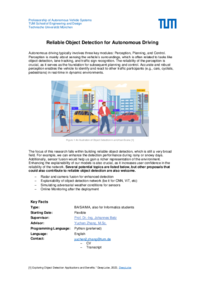
Autonomous driving typically involves three key modules: Perception, Planning, and Control. Perception is mainly about sensing the vehicle’s surroundings, which is often related to tasks like object detection, lane tracking, and traffic sign recognition. The reliability of the perception is crucial, as it serves as the foundation for subsequent planning and control. Accurate and robust perception enables the vehicle to identify and react to other traffic participants (e.g., cars, cyclists, pedestrians) in real-time in dynamic environments.
The focus of this research falls within building reliable object detection, which is still a very broad field. For example, we can enhance the detection performance during rainy or snowy days. Additionally, sensor fusion would help us gain a richer representation of the environment. Enhancing the explainability of our models is also crucial, as it increases user confidence in the reliability of the network. Several potential topics are listed below, but other proposals that could also contribute to reliable object detection are also welcome.1. Out-of-distribution perception
What happens when a detector encounters an object, scene, or situation that was never represented in its training data? Instead of confidently making a wrong prediction, can the system recognize: “I haven’t seen something like this before”?2. VLMs for autonomous-driving perception
Vision-Language Models have shown impressive generalization and semantic understanding. Can we use these capabilities to improve driving perception, especially for rare or unseen objects, while making VLM-based systems fast enough and reliable enough for real-time deployment?3. Uncertainty estimation
A detector gives us a prediction, but how do we know whether that prediction should be trusted? Can we accurately estimate uncertainty so that the system knows when it is confident, when it is uncertain, and when it should rely on additional information or another module?Key Facts:
Type: SA/MA, also for Informatics students
Starting Date: Flexible
Supervisor: Prof. Dr. Johannes Betz
Advisor: Yuchen Zhang
If you are interested, simply send an email with your CV and academic transcript to yuchen2.zhang@tum.de.
- Tags
- AVS Zhang
- Possible start
- sofort
- Contact
-
Yuchen Zhang
yuchen2.zhangtum.de - Announcement
-