High-Fidelity 3D Printing of Microstructured X-Ray Gratings
- Institut
- Lehrstuhl für Werkstoffwissenschaften (TUM-ED)
- Typ
- Bachelorarbeit Semesterarbeit Masterarbeit
- Inhalt
- experimentell
- Beschreibung
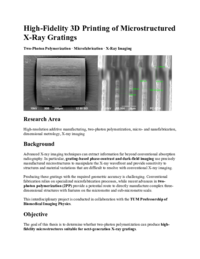
High-Fidelity 3D Printing of Microstructured X-Ray Gratings
Two-Photon Polymerization · Microfabrication · X-Ray Imaging · Metrology
Research Area
High-resolution additive manufacturing, two-photon polymerization, micro- and nanofabrication, dimensional metrology, X-ray imaging
Background
Advanced X-ray imaging techniques can extract information far beyond conventional absorption radiography. In particular, grating-based phase-contrast and dark-field imaging use precisely manufactured microstructures to manipulate the X-ray wavefront and provide sensitivity to structures and material variations that are difficult to resolve with conventional X-ray imaging.
Producing these gratings with the required geometric accuracy is challenging. Conventional fabrication relies on specialized microfabrication processes, while recent advances in two-photon polymerization (2PP) provide a potential route to directly manufacture complex three-dimensional structures with features on the micrometre and sub-micrometre scale.
This interdisciplinary project is conducted in collaboration with the TUM Professorship of Biomedical Imaging Physics.
Objective
The goal of this thesis is to determine whether two-photon polymerization can produce high-fidelity microstructures suitable for next-generation X-ray gratings.
The emphasis is not simply on achieving the smallest possible feature. Instead, the central challenge is to understand and control the complete relationship:
CAD geometry → 2PP process → printed geometry → dimensional error → functional grating quality
The project will systematically investigate how printing strategy and process parameters influence the quality of demanding high-aspect-ratio periodic structures.
Individual Tasks
Depending on the final scope, the work may include:
- Translating target X-ray grating geometries into 2PP-compatible CAD designs
- Designing test structures for systematic print-quality assessment
- Fabricating structures using a high-resolution two-photon polymerization printer
- Investigating process parameters such as:
- voxel size and orientation
- laser exposure
- slicing and hatching strategy
- print orientation
- feature spacing
- aspect ratio
- development and drying
- Quantifying dimensional accuracy and print fidelity using optical microscopy and/or SEM
- Evaluating deformation, shrinkage, collapse, surface quality, and feature-to-feature consistency
- Iteratively improving the designs and printing strategy
- Identifying a robust process window for repeatable grating fabrication
- Fabricating demonstrator gratings for subsequent X-ray characterization with the collaborating imaging group
Depending on progress, the project can also investigate more complex three-dimensional or non-conventional grating geometries that would be difficult to manufacture with traditional processes.
Research Questions
Examples of questions the thesis could address are:
- What minimum feature dimensions can be reproduced reliably rather than merely printed once?
- What limits the achievable aspect ratio?
- How do voxel geometry, scan strategy, development, and drying affect dimensional accuracy?
- Can predictable design compensation be introduced for systematic fabrication errors?
- Can 2PP enable grating geometries that are inaccessible to conventional fabrication routes?
- Voraussetzungen
Prerequisites
Required
- Strong interest in experimental microfabrication
- Careful and systematic laboratory working style
- Interest in optics, X-ray imaging, materials science, or precision manufacturing
- Experience with CAD or strong motivation to learn it
Beneficial
- Experience with additive manufacturing or lithography
- Optical or electron microscopy
- Image analysis, Python or MATLAB
- Fundamentals of optics or X-ray physics
- Experimental design and statistical analysis
Prior experience with X-ray imaging or two-photon polymerization is not required.
What You Will Learn
You will work at the interface between advanced manufacturing and biomedical imaging, gaining practical experience with:
- Two-photon polymerization
- High-aspect-ratio microfabrication
- CAD-to-print process development
- Optical and electron microscopy
- Quantitative dimensional metrology
- Design of experiments
- X-ray grating technology and phase-contrast imaging
Most importantly, the project has a clear engineering objective: determining whether an emerging additive-manufacturing process can replace or extend conventional routes for manufacturing precision X-ray optical components.
Suitable for: Master’s thesis / semester thesis
- Möglicher Beginn
- sofort
- Kontakt
-
Kneev Sharma
Raum: 2225
Tel.: +498928915294
kneev.sharmatum.de - Ausschreibung
-