Machine Learning Optimization of Architected 3D-Printed Electrodes
- Institut
- Lehrstuhl für Werkstoffwissenschaften (TUM-ED)
- Typ
- Bachelorarbeit Semesterarbeit Masterarbeit
- Inhalt
- experimentell theoretisch
- Beschreibung
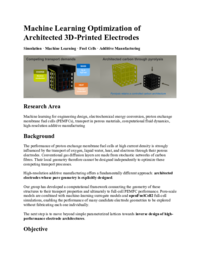
Machine Learning Optimization of Architected 3D-Printed Electrodes
Simulation · Machine Learning · Fuel Cells · Additive Manufacturing
Research Area
Machine learning for engineering design, electrochemical energy conversion, proton exchange membrane fuel cells (PEMFCs), transport in porous materials, computational fluid dynamics, high-resolution additive manufacturing
Background
The performance of proton exchange membrane fuel cells at high current density is strongly influenced by the transport of oxygen, liquid water, heat, and electrons through their porous electrodes. Conventional gas diffusion layers are made from stochastic networks of carbon fibres. Their local geometry therefore cannot be designed independently to optimize these competing transport processes.
High-resolution additive manufacturing offers a fundamentally different approach: architected electrodes whose pore geometry is explicitly designed.
Our group has developed a computational framework connecting the geometry of these structures to their transport properties and ultimately to full-cell PEMFC performance. Pore-scale models are combined with machine-learning surrogate models and openFuelCell2 full-cell simulations, enabling the performance of many candidate electrode geometries to be explored without fabricating each one individually.
The next step is to move beyond simple parameterized lattices towards inverse design of high-performance electrode architectures.
Objective
The goal of this thesis is to develop and apply a machine-learning optimization framework for architected PEMFC electrodes.
You will build on an existing simulation and ML workflow rather than starting from scratch. The central research question is:
Can we computationally generate electrode structures that outperform manually designed architectures while remaining physically manufacturable by high-resolution 3D printing?
Depending on the thesis scope and student interests, the project may involve:
- Extending the existing geometric design space beyond simple cubic structures
- Generating parameterized or algorithmically defined 3D electrode architectures
- Using existing transport-property models as fast structure evaluators
- Coupling predicted transport properties to full-cell simulations in openFuelCell2
- Applying Bayesian optimization, surrogate modelling, or other ML-based inverse-design approaches
- Developing multi-objective optimization criteria accounting for mass transport, heat transport, electrical resistance, and manufacturability
- Analysing the resulting structures to identify physically meaningful design rules
- Selecting optimized architectures for subsequent experimental fabrication and testing
The project can be tailored towards machine learning, computational modelling, or engineering design optimization, depending on the student’s background.
Existing Starting Point
A working framework already exists linking architected electrode geometry to pore-scale transport models, an artificial neural network surrogate, openFuelCell2 full-cell simulations, and Bayesian optimization.
Previous work has already demonstrated that the optimum cannot be understood from a single parameter such as permeability alone: competing effects from diffusion, electrical transport, and heat transfer produce non-trivial design trade-offs.
The thesis therefore begins from a functioning research platform and focuses on the more interesting problem: how should the next generation of structures actually be designed?
- Voraussetzungen
Prerequisites
Required
- Strong interest in computational engineering and numerical modelling
- Good programming skills, preferably Python
- Interest in machine learning or mathematical optimization
- Ability to work independently with an existing research codebase
Beneficial
- Experience with PyTorch, scikit-learn, Optuna, or similar ML/optimization tools
- Experience with OpenFOAM or CFD
- Experience with CAD or procedural geometry generation
- Knowledge of electrochemistry, fuel cells, or transport in porous media
- Experience with Linux and high-performance computing
Prior experience with fuel cells is helpful but not required.
What You Will Learn
By the end of the project, you will have experience combining:
- Machine learning and surrogate modelling
- Bayesian or multi-objective optimization
- Computational fluid dynamics
- Multiphysics fuel-cell simulations
- Architected porous materials
- Additive-manufacturing design constraints
Most importantly, you will work on a real simulation-to-manufacturing design problem, where optimized structures can subsequently be fabricated and experimentally tested.
Suitable for: Master’s thesis / semester thesis / research project
- Möglicher Beginn
- sofort
- Kontakt
-
Kneev Sharma
Raum: 2225
Tel.: +498928915294
kneev.sharmatum.de - Ausschreibung
-