From AI Design to Fuel-Cell Performance: Testing 3D-Printed Carbon Electrodes
- Institut
- Lehrstuhl für Werkstoffwissenschaften (TUM-ED)
- Typ
- Bachelorarbeit Semesterarbeit Masterarbeit
- Inhalt
- experimentell
- Beschreibung
From AI Design to Fuel-Cell Performance: Testing 3D-Printed Carbon Electrodes
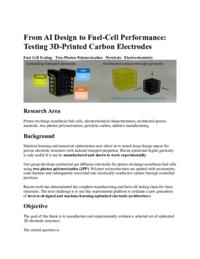
Fuel Cell Testing · Two-Photon Polymerization · Pyrolysis · Electrochemistry
Research Area
Proton exchange membrane fuel cells, electrochemical characterization, architected porous materials, two-photon polymerization, pyrolytic carbon, additive manufacturing
Background
Machine learning and numerical optimization now allow us to search large design spaces for porous electrode structures with tailored transport properties. But an optimized digital geometry is only useful if it can be manufactured and shown to work experimentally.
Our group develops architected gas diffusion electrodes for proton exchange membrane fuel cells using two-photon polymerization (2PP). Polymer microstructures are printed with micrometre-scale features and subsequently converted into electrically conductive carbon through controlled pyrolysis.
Recent work has demonstrated the complete manufacturing and fuel-cell testing chain for these structures. The next challenge is to use this experimental platform to evaluate a new generation of inverse-designed and machine-learning-optimized electrode architectures.
Objective
The goal of this thesis is to manufacture and experimentally evaluate a selected set of optimized 3D electrode structures.
The central question is:
Do structures predicted to perform well computationally actually deliver improved transport and electrochemical performance when manufactured and operated in a real PEM fuel cell?
The work is predominantly experimental and is complementary to a separate computational thesis on ML-based structure optimization.
Individual Tasks
Depending on the final project scope, the work will include:
- Preparing selected inverse-designed electrode geometries for manufacturing
- Fabricating structures using high-resolution two-photon polymerization
- Developing and optimizing printing parameters where required
- Post-processing and thermally curing the printed structures
- Carbonizing the structures through controlled pyrolysis
- Characterizing shrinkage, structural fidelity, and defects using optical microscopy and SEM
- Assembling printed carbon electrodes into a PEM fuel-cell test fixture
- Performing electrochemical characterization using:
- polarization curves
- electrochemical impedance spectroscopy (EIS)
- distribution of relaxation times (DRT)
- cyclic voltammetry where appropriate
- hydrogen crossover and cell-integrity measurements
- Comparing experimental performance with computational predictions and established baseline structures
- Identifying which geometric features actually control mass-transport and high-current performance
A major scientific outcome will be determining where simulation and experiment agree, and where they do not.
Existing Starting Point
The manufacturing and electrochemical testing workflow is already established.
Previous work has demonstrated:
- 2PP fabrication of architected porous electrodes
- Pyrolysis into freestanding conductive carbon structures
- Characterization of printing and pyrolysis-induced shrinkage
- Integration of printed electrodes into a PEMFC test fixture
- Electrochemical characterization through EIS, DRT, polarization curves, and related diagnostics
The project can therefore focus on comparing and understanding new optimized structures rather than developing the complete experimental platform from zero.
- Voraussetzungen
Prerequisites
Required
- Strong interest in experimental research
- Careful and systematic laboratory working style
- Interest in fuel cells, electrochemistry, or advanced manufacturing
- Willingness to work with delicate microstructured samples and multi-step fabrication processes
Beneficial
- Basic electrochemistry
- Experience with electrochemical testing or impedance spectroscopy
- Experience with additive manufacturing or microfabrication
- Experience with CAD
- Python or MATLAB for experimental data analysis
- Experience with optical microscopy or SEM
Previous experience with 2PP or fuel-cell testing is welcome but not required.
What You Will Learn
The project spans the full physical development cycle:
digital structure → 2PP printing → thermal processing → carbon electrode → fuel-cell testing → electrochemical analysis
You will gain practical experience in high-resolution additive manufacturing, pyrolysis of polymer-derived carbon, microscopy, PEMFC operation, EIS/DRT analysis, and experimental validation of computationally designed materials.
Suitable for: Master’s thesis / semester thesis
- Möglicher Beginn
- sofort
- Kontakt
-
Kneev Sharma
Raum: 2225
Tel.: +498928915294
kneev.sharmatum.de - Ausschreibung
-