Hypergraph Generation from Exploded-View Drawings
- Institut
- Institut für Werkzeugmaschinen und Betriebswissenschaften (TUM-ED)
- Typ
- Bachelorarbeit Semesterarbeit Masterarbeit
- Inhalt
- experimentell theoretisch
- Beschreibung
Context
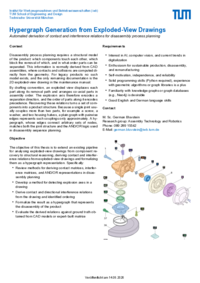
Disassembly process planning requires a structural model of the product: which components touch each other, which block the removal of which, and in what order parts can be separated. This information is normally derived from CAD assemblies, where contacts and collisions are computed directly from the geometry. For legacy products no such model exists, and the only remaining documentation is the 2D exploded-view drawing in the maintenance manual.
By drafting convention, an exploded view displaces each part along its removal path and arranges co-axial parts in assembly order. The explosion axis therefore encodes a separation direction, and the order of parts along it encodes precedence. Recovering these relations turns a set of components into a product structure. Because a single joint usually couples more than two parts, for example a screw, a washer, and two housing halves, a plain graph with pairwise edges represents such couplings only approximately. A hypergraph, whose edges connect arbitrary sets of nodes, matches both the joint structure and the AND/OR logic used in disassembly sequence planning.
Objective
The objective of this thesis is to extend an existing pipeline for analysing exploded-view drawings from component recovery to structural reasoning, deriving contact and interference relations from exploded-view drawings and formalizing them as a hypergraph representation. Specifically:
- Review methods for deriving contact matrices, interference matrices, and AND/OR representations in disassembly planning
- Develop a method for detecting explosion axes in a drawing
- Derive contact and directional interference relations from the drawing and identified ordering
- Formalize the result as a hypergraph that represents the disassembly of the product
- Evaluate the derived relations against ground truth obtained from CAD models or expert-built matrice
- Voraussetzungen
- Interest in robotics, AI, and current trends in digitalization
- Enthusiasm for sustainable production, disassembly, and remanufacturing
- Self-motivation, independence, and reliability
- Solid programming skills (Python required), experience with robot programming or ROS is a plus
- Hands-on interest in gripper design and pneumatics, and willingness to work in the laboratory
- Good English and German language skills
- Möglicher Beginn
- sofort
- Kontakt
-
German Bluvstein
Raum: 1303
Tel.: +49 89 289 15542
german.bluvsteiniwb.tum.de - Ausschreibung
-