Scale-Resolving Simulation of Roughness Effects in Additively Manufactured Micronozzles
- Institut
- Lehrstuhl für Raumfahrtantriebe (TUM-ED)
- Typ
- Masterarbeit
- Inhalt
- Beschreibung
Water Electrolysis Propulsion (WEP) is one of the most promising green propulsion technologies under development today. A WEP spacecraft is filled on the ground with pure water instead of highly toxic propellants and electrolyses it in orbit into hydrogen and oxygen, feeding hot- or cold-gas thrusters. Using water as a propellant, WEP is uniquely positioned to take advantage of in-orbit refuelling of satellites. The EIC Pathfinder Ice2Thrust project is developing a small satellite WEP system capable of refilling customer spacecraft in orbit. Realising this capability requires a thruster array capable of safe, precise six-degree-of-freedom manoeuvring.
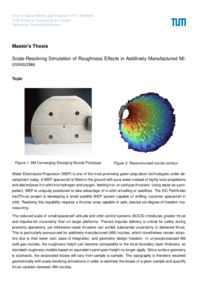
The reduced scale of small-spacecraft attitude and orbit control systems (AOCS) introduces greater thrust and impulse-bit uncertainty than on larger platforms. Precise impulse delivery is critical for safety during proximity operations, yet milinewton-scale thrusters can exhibit substantial uncertainty in delivered thrust. This is particularly pronounced for additively manufactured (AM) nozzles, which nonetheless remain attractive due to their lower cost, ease of integration, and geometric design freedom. In un-postprocessed AM cold-gas nozzles, the roughness height can become comparable to the local boundary layer thickness, so standard roughness models based on equivalent sand-grain height no longer apply. Since surface geometry is stochastic, the associated losses will vary from sample to sample. The topography is therefore resolved geometrically with scale-resolving simulations in order to estimate the losses of a given sample and quantify thrust variation between AM nozzles.
The objective of this project is to establish an experimentally correlated model of a millinewton-scale cold-gas thruster using Implicit Large Eddy Simulations in PyFR - an open-source, GPU-accelerated high-order flux reconstruction solver. The setup will first be correlated against existing experimental data for a converging-duct validation case, before moving on to predicting the thrust of a converging-diverging nozzle across a range of steady and transient inlet conditions. Finally, the resulting model will be used to quantify thrust variation between additively manufactured micronozzles, and how this variation can be reduced through design.
Building on an existing model setup and compute infrastructure, you will apply GPU-accelerated CFD methods to a flow regime that remains poorly characterised yet is highly relevant to future space applications. Your work will both draw on and complement X-ray microscopy data on nozzle surface roughness and steady-state and transient thrust measurements from the Ice2Thrust testbench.
As part of the Ice2Thrust team of students and researchers, you will gain hands-on experience in satellite propulsion system testing and contribute to delivering a complete hybrid-electric satellite propulsion system by mid-2027.
Tasks
- Familiarisation with geometry and conditions, review of relevant literature
- Baseline channel flow setup, grid resolution and surface roughness sensitivity study
- Comparison of boundary layer profiles to experimental discharge coefficients
- Converging-diverging nozzle simulation with thrust measurement
- Knudsen number evaluation and implementation of slip-flow boundary conditions
- Analysis of behaviour across inlet turbulence and Reynolds number
- Sensitivity analysis to resolved surface roughness variation
- Voraussetzungen
- Student in any engineering or informatics discipline.
- Basic familiarity with Linux and prior experience with Python required
- Strong understanding of CFD fundamentals
- Experience with or interest in scale-resolving simulations and high-performance computing workflows
- Möglicher Beginn
- sofort
- Kontakt
-
Tomas Mrazek, M.Eng.
Tel.: +33695349960
tomas.mrazektum.de - Ausschreibung
-