Spacecraft Reentry: Molecular Dynamics Study of Coking in Phenol-based Thermal Protection Materials
- Institut
- Lehrstuhl für Thermodynamik (TUM-ED)
- Typ
- Masterarbeit
- Inhalt
- Beschreibung
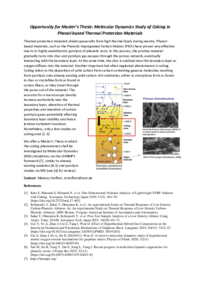
Thermal protection materials shield spacecrafts from high thermal loads during reentry. Phenol-based materials, such as the Phenolic Impregnated Carbon Ablator (PICA) have proven very effective due to to highly endothermic pyrolysis of phenolic resin. In this process, the pristine material gradually turns into char and pyrolysis gas escapes through the porous network, eventually interacting with the boundary layer. At the same time, the char is oxidized near the boundary layer as oxygen diffuses into the material. Another important but often neglected phenomenon is coking. Coking refers to the deposition of solid carbon from carbon-containing gaseous molecules resulting from pyrolysis onto already existing solid carbon-rich substrates, either in amorphous form as found in char or crystalline form as found in carbon fibers, as they travel through the pores out of the material. This accounts for a macroscopic density increase particularly near the boundary layer, alteration of thermal properties and retention of certain pyrolysis gases potentially affecting boundary layer stability and hence laminar-turbulent transition. Nonetheless, only a few studies on coking exist [1-3].
We offer a Master’s Thesis in which the coking phenomenon shall be investigated by Molecular Dynamics (MD) simulations via the LAMMPS framework [7], similar to already existing oxidation [4,5] and pyrolysis studies via MD (see [6] for review).
References:
[1] Kato S, Matsuda S, Shimada N, et al. One-Dimensional Ablation Analysis of Lightweight CFRP Ablators with Coking. Aerospace Technology Japan 2019; 17(4): 461–70
[https://doi.org/10.2322/tastj.17.461][2] Kobayashi Y, Sakai T, Okuyama K, et al. An experimental Study on Thermal Response of Low Density Carbon-Phenolic Ablators. In: An experimental Study on Thermal Response of Low Density Carbon-Phenolic Ablators; 2009. Reston, Virigina: American Institute of Aeronautics and Astronautics.
[3] Sakai T, Okuyama K, Kobayashi Y, et al. Post-Test Sample Analysis of a Low Density Ablator Using Arcjet. Trans. JSASS Aerospace Tech. Japan 2012; 10(28): 65–71.
[4] Cao Y, Ye Z, Zhao J, Cui Z, Tang J, Wen D. Effect of Hyperthermal Hybrid Gas Composition on the Interfacial Oxidation and Nitridation Mechanisms of Graphene Sheet. Langmuir 2024; 40(14): 7422–32
[https://doi.org/10.1021/acs.langmuir.3c03851][PMID: 38544283][5] Cui Z, Zhao J, He L, Jin H, ZHANG J, Wen D. A reactive molecular dynamics study of hyperthermal atomic oxygen erosion mechanisms for graphene sheets. Physics of Fluids 2020; 32(11)
[https://doi.org/10.1063/5.0030749][6] Fan M, Xu B, Yang Y, Dai S, Song L, Yang J. Recent progress in molecular dynamics approaches for phenolic resins. J Polym Res 2025; 32(11)
[https://doi.org/10.1007/s10965-025-04621-8][7] https://lammps.org/
- Voraussetzungen
- Interest in molecular chemistry
- Familiarity with Linux (WSL) is an asset
- Möglicher Beginn
- immediately
- Kontakt
-
M.Sc. Mateusz Hoffert
Raum: 5507.EG.726
Tel.: +49 (89) 289 - 16253
m.hofferttum.de - Ausschreibung
-