Response Analysis of Event-Based Vision Sensors to Point Light Sources for Space Missions
- Institute
- Lehrstuhl für Spacecraft Systems (TUM-ED)
- Type
- Semester Thesis Master's Thesis
- Content
- experimental
- Description
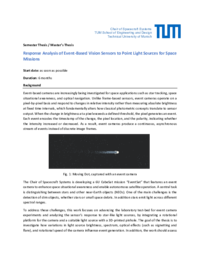
Event-based cameras are increasingly being investigated for space applications such as star tracking, space situational awareness, and optical navigation. Unlike frame-based sensors, event cameras operate on a pixel-by-pixel basis and respond to changes in relative intensity rather than measuring absolute brightness at fixed time intervals, which fundamentally alters how classical photometric concepts translate to sensor output. When the change in brightness at a pixel exceeds a defined threshold, the pixel generates an event. Each event encodes the timestamp of the change, the pixel location, and the polarity, indicating whether the intensity increased or decreased. As a result, event cameras produce a continuous, asynchronous stream of events instead of discrete image frames.
The Chair of Spacecraft Systems is developing a 6U CubeSat mission “EventSat” that features an event camera to enhance space situational awareness and enable autonomous satellite operation. A central task is distinguishing between stars and other near-Earth objects (NEOs). One of the main challenges is the detection of dim objects, whether stars or small space debris. In addition stars emit light across different spectral ranges.
To address these challenges, this work focuses on advancing the laboratory test-bed for event camera experiments and analyzing the sensor’s response to star-like light sources, by integrating a rotational platform for the camera and a suitable light source with a 3D-printed pinhole. The goal of the thesis is to investigate how variations in light source brightness, spectrum, optical effects (such as vignetting and flare), and rotational speed of the camera influence event generation. In addition, the work should assess the gap between the controlled laboratory experiments and real field observations with a telescope from Earth.- Requirements
- Enrolled in a Master’s program of Aerospace Engineering.
- Interest in computer vision, space systems, and astronomy.
- Basic CAD skills.
- Knowledge in Python programming.
- Knowledge in optics and sensors is a plus.- Possible start
- sofort
- Contact
-
Lara Schuberth
lara.schuberthtum.de - Announcement
-