Human-Robot Prediction Model from Motion Tracking Data (EN)
- Institute
- Lehrstuhl für Ergonomie (TUM-ED)
- Type
- Bachelor's Thesis Semester Thesis Master's Thesis
- Content
- experimental theoretical constructive
- Description
Background and Objective
In modern industrial environments, mobile robots increasingly operate in close proximity to human workers. However, interactions between humans and machines are still far from achieving the naturalness, efficiency, and safety typically found in human-to-human encounters. One key challenge lies in the insufficient modeling of human motion behavior in simulations. While human models are already used in the development of navigation algorithms, these are often based on highly simplified assumptions. This is where machine learning comes in.
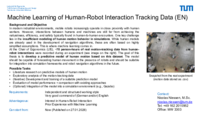
At the Chair of Ergonomics (LfE), approximately 40 person-hours of real motion-tracking data from human-robot interactions were recorded during an experiment (see image on the right). The goal of this thesis is to develop a predictive model of human motion based on this dataset. The model should be capable of forecasting human movement in the presence of robots and should be suitable for integration into simulation frameworks and robot navigation algorithms in the future.
Possible Tasks
-
Literature research on predictive models of human motion
-
Exploratory analysis of the motion-tracking data
-
(Iterative) Development and training of a suitable prediction model
-
Evaluation of model performance + comparison with existing approaches
-
(Optional) Integration of the model into a simulation environment (e.g., Gazebo)
-
- Requirements
Requirements:
-
Independent and structured working style
-
Very good command of (German and/or) English
Advantageous:
-
Interest in Human-Robot Interaction
-
Prior Experience with Machine Learning
-
- Tags
- LfE Niessen
- Possible start
- now
- Contact
-
Nicolas Niessen, M.Sc.
Room: MW 3303
nicolas.niessentum.de - Announcement
-