Development of an evaluation pipeline for a real autonomous vehicle
- Institut
- Lehrstuhl für Robotik, Künstliche Intelligenz und Echtzeitsysteme (TUM-CIT)
- Typ
- Semesterarbeit
- Inhalt
- Beschreibung
Background
Autonomous driving (AD) has seen a spike of interest in recent years. A crucial part of each
real-world autonomous driving project is a large-scale evaluation pipeline, as this is the only
way to reliably validate code that should be good enough to be trusted in real-world deployment
for autonomous driving.
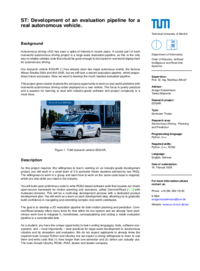
Our research vehicle EDGAR [1] has already seen two major autonoous events, the famous
Wiesn-Shuttle 2024 and IAA 2025, but we still lack a decent evaluation pipeline, which jeopar-
dizes future successes. Now, we want to develop the much needed evaluation pipeline.
This project gives master students the exclusive opportunity to work on real-world problems with
real-world autonomous driving codes deployed on a real vehicle. The focus is purely practical
and a passion for learning to deal with industry-grade software and project complexity is a
must-have.Description
As this project requires (the willingness to learn) working on an industry-grade development
project, you will work in a small team of 2-3 semester thesis students advised by two PhDs.
The willingness to work in a group and learn how to work on the same code base is required,
which are also skills you need in the industry.
You will build upon preliminary code to write ROS2-based software suite that couples our chairs
open-source framework for motion planning and scenarios, called CommonRoad [1, 2] with
Autoware.Universe. This will be a multi-step development process with a dedicated product
development plan. You will work as a team on each development step, allowing you to gradually
build confidence in navigating and extending complex real-world codebases.
The goal is to develop a 2D evaluation pipeline for both motion planning and prediction. Com-
monRoad already offers many tools for that within its eco-system and we already have preli-
minary work how to integrate it, nonetheless, conceptualizing and coding a viable evaluation
pipeline is a considerable task.
As a student, you have the unique opportunity to learn coding languages, tools, software eco-
systems, and – most importantly – best practices for large-scale development in autonomous
robotics and its simulation and evaluation. We do not expect applicants to already know the
required tools (except Python and Ubuntu) but we expect a strong willingness to learn to use
them and write code that (1) lives longer than one semester and (2) others can actually use.
The tools include Ubuntu, ROS2, RVIZ, docker and docker-compose.Tasks
As this project has an above-average complexity, you will follow a product development process
developed by an experienced PhD (at least at the beginning). Familiarization with the tools –
especially ROS2 – and lessons on how to set up a long-living project and write decent code are
key parts in the first month.
The tasks are structured to begin with simpler implementations, allowing you to familiarize
yourself with the topic while steadily making progress. As your understanding deepens, the
complexity increases, leading you to more advanced topics after roughly two months.
The task the group will work on are:
1. Familiarization with docker, ROS2 and the very basics of our EDGAR code.
2. Learn how to implement a simple ROS2 node for mcap data recording (example code
already exists).
3. Transform the recorded mcap data into a CommonRoad scenario (example code already
exists but may need minor revisions).
4. Develop a simple way to read-in a planning problem from a CommonRoad file, trigger the
automatic execution of the EDGAR pipeline and record the vehicle driving in simulation.
5. Develop a simple way to read-in the dynamic traffic participants from a CommonRoad
file, spawn them into the simulation and let them drive upon automatic activation of the
EDGAR pipeline.
6. Develop a simple way of reading in traffic signs and traffic lights from a CommonRoad
file and map them into the simulation.
7. Now that major parts of a scenario are considered, you can use the transformed sce-
nario from step 2 with existing CommonRoad tools to evaluate safety (CommonRoad
Drivability Checker) and comfort (CommonRoad Cost Functions).
8. You can also use the CommonRoad STL monitor to evaluate traffic rule compliance.
9. (Optional) Once a prototype is developed you can spend the remaining time improving
“simple way implementations” above to more sophisticated ones.
We want to stretch again that – at least in the beginning – you will not distribute tasks but work
on the same task together to build up a common knowledge base and understanding.
- Voraussetzungen
This project gives master students the exclusive opportunity to work on real-world problems with
real-world autonomous driving codes deployed on a real vehicle. The focus is purely practical
and a passion for learning to deal with industry-grade software and project complexity is a
must-have.As a student, you have the unique opportunity to learn coding languages, tools, software eco-
systems, and – most importantly – best practices for large-scale development in autonomous
robotics and its simulation and evaluation. We do not expect applicants to already know the
required tools (except Python and Ubuntu) but we expect a strong willingness to learn to use
them and write code that (1) lives longer than one semester and (2) others can actually use.
The tools include Ubuntu, ROS2, RVIZ, docker and docker-compose.Application
If you are interested in the topic, please send an email to the contact information provided on
the right and attach a short CV, your current grade report and your bachelor grade report.
If you have extra-curricular projects or a student job, please attach information about it.- Möglicher Beginn
- sofort
- Kontakt
-
Tobias Mascetta, M.Sc.
Raum: 5607.03.060 (MPI Building, Floor 3, Part 7)
tobias.mascettatum.de - Ausschreibung
-