Investigation of the Influence of Turbulence and Transition Modelling on Flow in Rotor-Stator-Cavities in Aircraft Engine Secondary Air Systems
- Institut
- Lehrstuhl für Test und Simulation für Gasturbinen
- Typ
- Bachelorarbeit
- Inhalt
- theoretisch
- Beschreibung
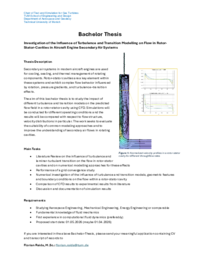
Secondary air systems in modern aircraft engines are used for cooling, sealing, and thermal management of rotating components. Rotor–stator cavities are a key element within these systems and exhibit complex flow behavior influenced by rotation, pressure gradients, and turbulence–transition effects. The aim of this bachelor thesis is to study the impact of different turbulence and transition models on the predicted flow field in a rotor–stator cavity using CFD. Simulations will be conducted for different operating conditions and the results will be compared with respect to flow structure, velocity distributions in particular. The work seeks to evaluate the suitability of common modeling approaches and to improve the understanding of secondary air flows in rotating cavities.
- Voraussetzungen
Studying Aerospace Engineering, Mechanical Engineering, Energy Engineering or comparable
Fundamental knowledge of fluid mechanics
First experience in computational fluid dynamics (preferably)
- Partner Institution
- German Aerospace Center (DLR)
- Tools:
- TRACE, Python
- Möglicher Beginn
- 01.05.2026 (maybe earlier)
- Kontakt
-
Florian Raida, M.Sc.
Raum: 5506.EG.631
Tel.: +49 89 289 16533
florian.raidatum.de - Ausschreibung
-