Correlation of Geometry with Acoustic Properties for Lattice Structures
- Institut
- Lehrstuhl für Akustik mobiler Systeme (TUM-ED)
- Typ
- Masterarbeit
- Inhalt
- Beschreibung
Background
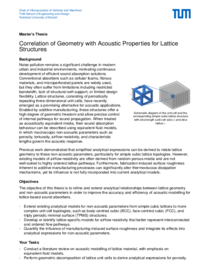
Noise pollution remains a significant challenge in modern urban and industrial environments, motivating continuous development of efficient sound absorption solutions. Conventional absorbers such as cellular foams, fibrous materials, and microperforated panels are widely used, but they often suffer from limitations including restricted bandwidth, lack of structural self-support, or limited design flexibility. Lattice structures, consisting of periodically repeating three-dimensional unit cells, have recently emerged as a promising alternative for acoustic applications. Enabled by additive manufacturing, these structures offer a high degree of geometric freedom and allow precise control of internal pathways for sound propagation. When treated as acoustically equivalent media, their sound absorption behavior can be described using equivalent-fluid models, in which macroscopic non-acoustic parameters such as porosity, tortuosity, airflow resistivity, and characteristic lengths govern the acoustic response.
Previous work demonstrated that simplified analytical expressions can be derived to relate lattice geometry to these non-acoustic parameters, particularly for simple cubic lattice topologies. However, existing models of airflow resistivity are often derived from random porous media and are not well-suited to highly ordered lattice pathways. Furthermore, fabrication-induced surface roughness inherent to additive manufacturing processes can significantly alter thermoviscous dissipation mechanisms, yet its influence is not fully incorporated into current analytical models.
Objectives
The objective of this thesis is to refine and extend analytical relationships between lattice geometry and non-acoustic parameters in order to improve the accuracy and efficiency of acoustic modeling for lattice-based sound absorbers.
- Extend existing analytical models for non-acoustic parameters from simple cubic lattices to more complex unit cell topologies, such as body-centered cubic (BCC), face-centered cubic (FCC), and triply periodic minimal surface (TPMS) structures.
- Develop or identify lattice-specific models for airflow resistivity that better represent interconnected and ordered flow pathways.
- Quantify the influence of manufacturing-induced surface roughness and integrate its effects into analytical expressions for non-acoustic parameters.
- Voraussetzungen
Your Tasks
- Conduct a literature review on acoustic modeling of lattice material, with emphasis on equivalent-fluid models.
- Perform geometric decomposition of lattice unit cells to derive analytical expressions for porosity, tortuosity, and characteristic lengths.
- Use COMSOL Multiphysics to numerically extract non-acoustic parameters based on Laplace and Stokes flow simulations for validation of analytical models.
- Design and fabricate lattice specimens using additive manufacturing techniques (eg\FDM) with varying unit cell geometries and relative densities.
- Perform impedance tube measurements to obtain sound absorption coefficients and compare experimental results with analytical and numerical predictions.
- Analyze surface roughness using microscopy and assess its impact on acoustic performance through supplementary simulations.
Requirements
- Experience with computer-aided design (CAD), ideally using SolidWorks, for complex three-dimensional geometries.
- Proficiency in numerical simulation tools, particularly COMSOL Multiphysics and MATLAB.
- Strong analytical skills for geometric modeling and mathematical derivation.
- Practical aptitude for additive manufacturing and acoustic measurements using an impedance tube.
- Ability to critically analyze discrepancies between theoretical models, numerical simulations, and experimental data.
- Möglicher Beginn
- sofort
- Kontakt
-
Tao Yang, Ph.D.
Raum: MW 1534
Tel.: 089 289 55131
tao.yangtum.de - Ausschreibung
-